
गृहपृष्ठ Book Review: Why Nepal’s development, good governance falls short
Book Review: Why Nepal’s development, good governance falls short
Kathmandu : Good governance is not a new lexicon in our polity. This term has come into the centre of debate of development and governance practice mainly after the restoration of multiparty democracy in the 1990s.
Nepali scholars like Mahesh Chandra Regmi, Devendra Raj Pandey, Pitambar Sharma, and some other noted scholars wrote about this issue repeatedly, urging both politicians and bureaucrats sensitizing to the imperatives of good governance and, at the same time, warning of its repercussions to the extent that a nation could pay a heavy price if it fails to deliver.
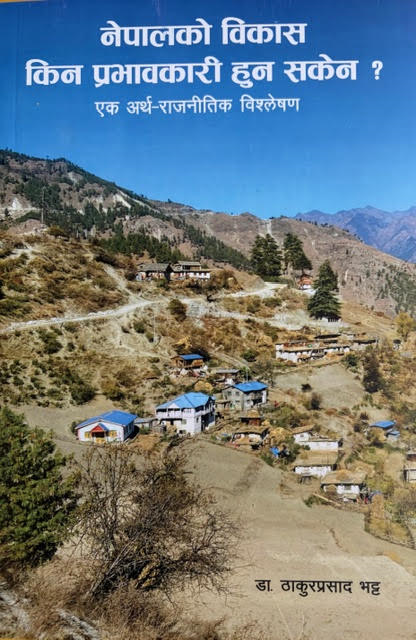
Recently, Dr Thakur Bhatta has come up with his new book “Why Nepal’s Development Could Become Effective” – a political economy analysis structured into ten chapters. Dr Bhatta, an academic and researcher by profession, unveiled his book at a critical juncture when Nepal has embarked on post-election crossroads after the formation of the new government following the landslide victory of a new political party, Rastriya Swatantra Party (RSP). The RSP gained an astounding majority in the March 5 House of Representatives (HoR) election by promising to give good governance, development and political stability, which the legacy political parties failed despite their tall promises.
Dr Bhatta’s book is a compilation of critical reflections on our governance, development, political parties and their leadership, and mostly importantly, the recommendations to address people’s unmet aspirations for prompt service delivery, improved livelihoods and economic prosperity. This book is timely, practically oriented and captures public sentiments for good governance. The crux of this book is the Nepali state’s failure to deliver good governance.
In his entire book, this author adopts a balanced stance to name the term Gen-Z Incident, against the backdrop that its supporters have called it the Gen-Z Movement while opponents characterize it as destruction.
This book is all about the failure of the political parties and the governments formed after the republican system and the detailed description from the economic-political perspective, the modus operandi of governance, system of development planning mechanisms, role of the political parties and bureaucracy in development and good governance and the role of civil society organizations and evidence-based policy formulation among others.
He goes on to mention that political economy and development cannot be described separately and suggests that the political leadership should be consistently cautious and strategically clear on the political goals to achieve the designed targets.
Politics, economic policy and development should be construed in totality. But he expresses reservations to our nation’s failure to deliver socio-economic transformation in line with the current constitution’s goal of a socialism-oriented economic framework. He answers why every political transformation fails to adequately serve society, while concluding that every successive government could not meet the minimum promise of governance and development because of their lacklustre performance, greed for personal gains and ultimately serving their self-serving interests.
Divided into ten chapters, the book provides a detailed account about political economy and development issues; political parties, civic participation and democratic accountability; government’s directives, commitments and challenges; distortions in development practice and innovative roadmaps; bureaucracy and research and development; land use master plan, production and agricultural development; policy formulation, monitoring and evaluation; federalism in Nepal’s development endeavours, local government and inclusive development, and state-public relations.
And, most of his chapters evolve through the call for good governance, are anchored in the call for social justice and prosperity, and the writer has focused on empowering the local government and run a ‘Good Governance Desk’ to facilitate the service-seekers in accessing public services. Similarly, Dr Bhatta has prioritized massive scale of public participation by bringing in all marginalized communities on board at the grassroots to ensure sustainable development.
Dr Bhatta points out bureaucratic red tape as a salient feature of Nepal’s bureaucracy that perpetuates anomalies and malpractices, adding that this is largely due to the absence of accountability. The main mantra the author shares in this book is ‘uphold the spirit of good governance’ to grow as a sovereign nation.
The writer explicitly shows his inclination towards a socialist-oriented development approach and, for this to materialize, emphasizes to shape the existing pattern of development into a transformative development model, as well as suggested [suggests] that political leaders should receive training on development since they are required to be familiar with the overall cycle of development including policymaking, implementation and assessment. He also offers insightful recommendations to the politicians to form teams of thematic, and operate institutionally.
In chapter 5, Dr Bhatta emphasizes the founding of the institution, a streamlined bureaucratic apparatus and research-based action plan for development, adding that mere establishment of the institution will not suffice if they are not backed by research findings.
The author offers some feedback to the legacy parties and leaders asking them either to mend their ways or get ready to face the collapse, and asks the leaders to live a simple life and be people-centric.
Interestingly, as the debate continues whether the government should recognize the trade unions in bureaucracy in the wake of new civil service bill, Dr Bhatta in this book argues that the dissolution of the trade union is both necessary and feasible for realigning political parties onto the right track. He states, “…sooner the trade unions are dissolved, the public service delivery will be fair and impartial. The trade unions are the tools of administrative anomalies and corruption. The way government offices, universities, schools, health care institutions are in chaotic situation, the main reason behind such things is the wrong move of the party-aligned trade unions.”
In a sub-title ‘Development, Politician and Expert’, Dr Bhatta argues that Nepal’s immediate priority, for now, is supply of basic level of development rather than high-end development outputs. But, unfortunately, that too has fallen short. In this aspect, Dr Bhatta heavily criticizes the politicians’ performative development projects of building view towers, unproductive infrastructures, city halls and others, which he terms a total fiasco and a manifestation of fiscal profligacy.
This is, he argues, is due to our cynical judgment in selecting the development projects that come out of mediocre planners and politicians who lack rational and objective capacity to prioritize the national development needs on the basis of public needs and fair judgment.
In his book, the writer seems an ardent critic of a traditionally structured and non-professional bureaucracy and calls it a major structural bottleneck for transformation, and sees the need for an accountable, forward-looking and esteemed civil service.
Published Time: 15:23 PM